![Phoenix Personal Injury Lawyer [Top Rated] | Gage Mathers Law Group](https://gagemathers.com/wp-content/uploads/2023/08/logo.png)
Free Consultation (602) 258-0646
No Fee Unless You Win
No Fee Unless You Win
Car accident fault determination is a critical process in any accident, as it plays a key role in determining liability in a car accident. When an accident occurs, various factors such as traffic laws, witness statements, and physical evidence are analyzed to establish which party is at fault. Insurance companies, along with police reports, use these findings to assess the extent of each driver’s responsibility.
This determination not only affects compensation but can also influence legal proceedings if the case goes to court. Having the best car accident lawyer can help ensure that liability is fairly assigned and protect your rights in the process.
At Gage Mathers, our fearless team of personal injury lawyers will work tirelessly to get you justice and the highest possible financial award after an accident.
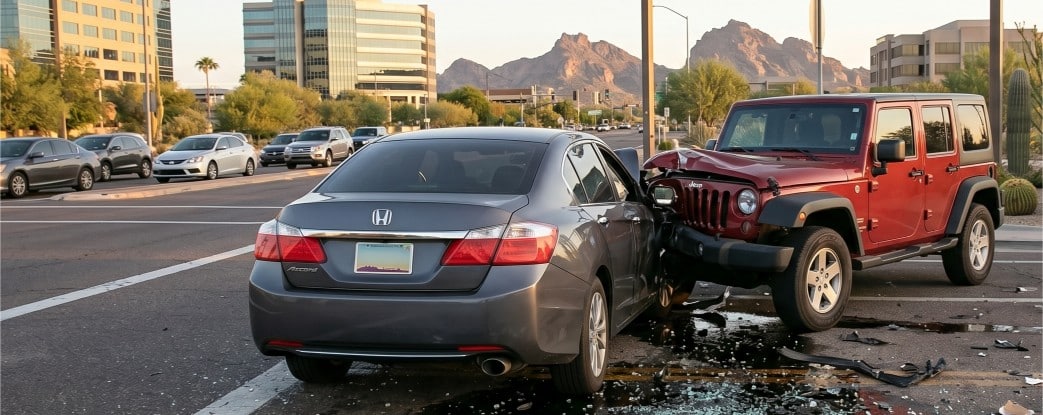
When it comes to determining fault in personal injury cases, the legal system relies on the concept of negligence. Unlike car accident claims that often follow predictable patterns, personal injury cases require a deeper analysis of whether someone failed to act with reasonable care.
To establish fault, four key elements must be proven:
This framework applies across a wide range of personal injury scenarios, not just motor vehicle accidents. The burden of proof lies with the injured party, meaning evidence must clearly show how each of these elements is met.
Arizona also follows a pure comparative negligence rule, which applies broadly in personal injury cases. This means fault can be shared between multiple parties, and compensation is reduced based on each person’s percentage of responsibility. Even if you are partially at fault, you may still recover damages.
Understanding this legal foundation is essential, as it shapes how liability is argued, negotiated, and ultimately decided in any personal injury claim.
While many people associate fault with car accidents, determining fault in personal injury cases extends far beyond collisions. Each type of case involves different legal standards, evidence, and strategies.
Unlike car accident claims, where police reports and vehicle damage are central, personal injury cases often rely on different forms of evidence depending on the situation:
Because each case type has unique requirements, building a strong claim means identifying the right kind of evidence for that specific injury scenario.
If your injury involved a motor vehicle, you can explore our more detailed breakdown of collision-specific liability in our dedicated car accident fault guide. However, for broader personal injury claims, understanding how negligence and evidence apply across different situations is key to protecting your rights.
| Personal Injury Case Type | Who May Be at Fault | Key Evidence Used | Why It Matters for Fault |
|---|---|---|---|
| Slip and Fall (Premises Liability) | Property owner, business operator | Maintenance logs, surveillance footage, incident reports | Shows whether a hazard existed and if it was ignored |
| Dog Bite/Animal Attack | Pet owner or handler | Animal control records, witness statements, medical reports | Helps prove the owner failed to control the animal |
| Negligent Security | Property owner, landlord, business | Security footage, prior incident reports, security policies | Establishes whether proper safety measures were lacking |
| Product Liability | Manufacturer, distributor, retailer | Product testing data, recalls, expert analysis | Identifies defects and links them to the injury |
| Workplace/Third-Party Injury | Contractor, equipment manufacturer, third party | Safety reports, training records, equipment inspections | Determines if negligence extends beyond the employer |
| General Personal Injury (All Types) | One or multiple parties | Medical records, expert testimony, photos, documentation | Connects the injury directly to the negligent action |
If you’ve been in an accident, you aren’t alone. In 2020, the National Highway Traffic Safety Administration reported more than five million police-reported crashes, which left more than two million people injured and thousands killed. Another 3.5 million crashes only reported damage to the car and other property.
The legal process can be difficult–even if you don’t suffer major damage or injuries. There are different methods to determine who’s at fault, and all are important if you’re seeking accident settlements for car accidents.
At the scene of an accident, it’s easy to say something that accidentally implies fault. This can unintentionally incriminate you or the other party.
Rather than acting in the heat of the moment, take the time to gather driver’s license and insurance information from anyone involved in the accident. Take photos, exchange contact information, and wait for the police, if necessary. This is important for properly reporting the accident.
When police are on the scene of an accident, they investigate, assess injuries, and review damage. This information could determine the severity of the crash and who is at fault.
Some cases are more obvious than others, such as when a person runs a red light or rear-ends a car in front of them. By creating scene diagrams and interviewing witnesses, the police may determine if any drivers involved were distracted, speeding, or under the influence.
Police reports are crucial and influential documents for insurance claims and legal proceedings, but they’re not always perfect. Without an officer present, you can file a report at the closest police station or online to protect yourself in future legal proceedings.
Filing an insurance claim is not hard. Anyone involved in an accident can file a claim with their insurance company almost instantly online or over the phone. Once all parties have submitted their claims, the insurance companies talk to each other and decide who’s at fault.
Depending on the type of coverage you have, your insurance company will work with you to assess and pay damages. If you are not at fault, your insurance company could go after the other party to pay for damages and, in some cases, refund your deductible.
Insurance companies tend to maximize blame to avoid paying claims. However, even if you’re at fault, you could still have a case.
Insurers don’t always agree. When they can’t decide who’s liable, the case may end up in arbitration. During arbitration, a private entity looks at the damage and determines fault.
This approach is common and can streamline the resolution process. This can be a logical alternative to lengthy legal proceedings.
If necessary, you could end up in a courtroom, leaving your fate to a jury. In court, juries are the ultimate determiners of fault. Most claims are settled before they reach this stage, which can be a lengthy and costly process. Different states have different rules, so it’s important to consult an attorney about the state’s laws and proceedings.
Even if you feel you may be at fault, it’s possible to share the blame in an accident. A personal injury lawyer can fully evaluate your accident circumstances and find a way to minimize fault as you recover. The team at Gage Mathers Law Group has extensive experience and can help you get the best possible outcome!

Phoenix is known for having the most crashes of any city in Arizona. The best accident lawyers in Arizona, such as Gage Mathers, have more than five decades of experience in Arizona car accident and ...
Posted by Joseph D'Aguanno
The impact of population growth on accidents is well-recognized. As more drivers enter the roadway, the rate of accidents and fatalities increases. States, counties, and cities try to mitiga...
read morePosted by Joseph D'Aguanno
States with stronger traffic safety laws and consistent enforcement often see better roadway safety outcomes, while areas with weaker enforcement or less strict compliance can experience higher c...
read moreIf you or a loved one has been seriously injured, please fill out the form below for your free consultation or call us at (602) 258-0646
 (602) 258-0646